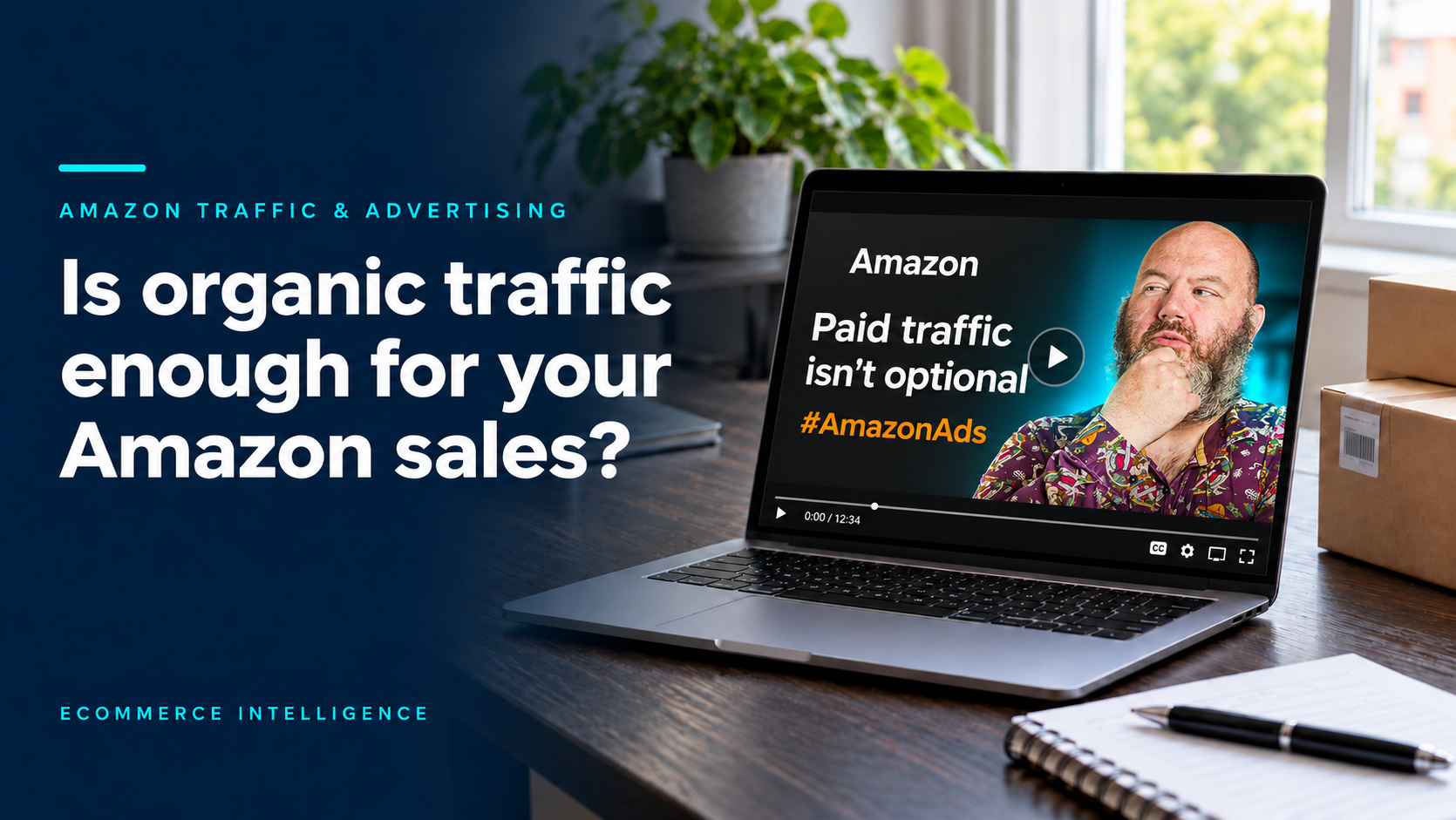

Amazon organic traffic can still bring customers to your products. The question is whether it can sustain the sales your business needs. If sponsored placements appear ahead of your listing, a strong organic position may give you less visibility than you expect.
In the video below, Chris Turton challenges the assumption that you can build rankings, switch off advertising and expect sales to continue unchanged. The practical starting point is to understand what brings shoppers to your products and what helps them buy.
Watch Chris’s video: Amazon Organic Is Dead. Here’s What To Do To Keep Getting Traffic (6 minutes 55 seconds).
Check how visible your products really are
Search for the terms your customers use and look at the results on mobile as well as desktop. Note where sponsored placements appear and how far shoppers need to scroll to reach your product. Results vary, so a single search is a snapshot rather than a reliable measure of your overall visibility.
Review important terms regularly alongside your performance data. Amazon PPC management can help you reach shoppers through paid placements, but the budget each product needs depends on demand, competition and margins. Advertising is not automatically necessary at the same level for every product.
Separate advertising results from organic performance
A drop in sales after reducing ads does not, by itself, prove that organic rankings have fallen. You have removed a source of paid traffic. Stock availability, pricing, promotions and competitors’ activity may also affect the result.
Compare advertising spend, clicks and attributed sales with total product sales over comparable periods. Track organic keyword positions separately. Sales attributed to an ad are not automatically sales that would never have happened without it, and the difference between total sales and ad-attributed sales is not a precise measure of organic search sales.
Fix the reasons shoppers leave without buying
Chris’s central point is useful: more traffic cannot resolve every product-page problem. If shoppers cannot tell what is included, whether an item fits or why it suits them, increasing bids may simply send more people to the same unanswered questions.
Start your Amazon listing optimisation with the information customers need to decide. Check that:
- The main image clearly shows the product at thumbnail size.
- The title identifies the product and its important specifications.
- Images and bullets explain size, compatibility and pack contents.
- A+ Content, where available, answers useful questions without repeating the listing.
- Price, availability and delivery expectations remain competitive.
Use recurring questions and genuine review feedback to identify gaps. Amazon’s product-page guidance also recommends improving the information shoppers see before increasing traffic.
Change advertising budgets against a clear baseline
Avoid switching off every campaign for an important product simply to see what happens. First record its sales, ad spend, conversion measures, stock position and profit after relevant costs. Agree which result would justify a change and how much downside the business can accept.
Where testing is appropriate, make a limited, documented adjustment and allow enough data to build before drawing conclusions. Account for promotions, seasonal demand and changes to the listing. A lower advertising cost of sales (ACoS) alone does not prove the business is more profitable if total sales or margins have deteriorated.
Start with one important product and establish whether its main constraint is visibility, conversion or margin. If you need help interpreting the findings, our Amazon consultancy can help you decide where to focus next.